
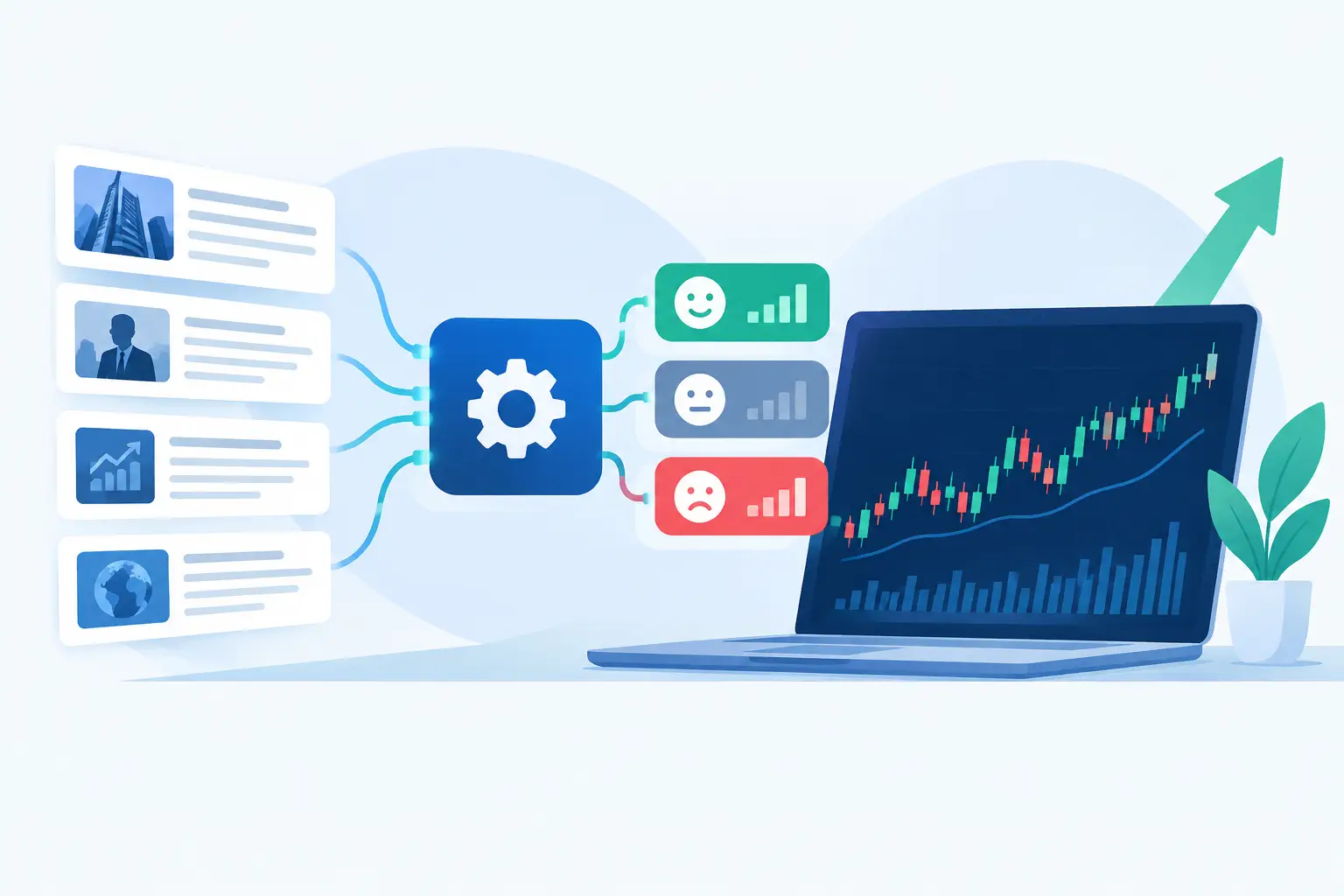
A ticker can move long before a conventional chart scan explains why. A regulatory filing hits, a credible outlet publishes a detail, social discussion accelerates, and the conversation changes character. By the time volume confirms the move, the early information edge may be gone. A stock news and sentiment API gives traders, analysts, and developers a structured way to detect that shift while the narrative is still forming.
The key word is structured. Raw headlines and social posts are not intelligence. They are an unfiltered stream of duplicate coverage, stale reactions, low-quality claims, and occasional signal. An effective API turns that stream into ticker-level evidence that can be screened, scored, alerted on, and tested against price behavior.
What a Stock News and Sentiment API Should Deliver
At a basic level, an API should associate relevant news and public conversation with the correct ticker, classify the tone of that coverage, and make the results available with enough speed for active market workflows. But basic sentiment alone is rarely enough.
A headline labeled positive does not automatically represent a meaningful catalyst. A favorable earnings comment may already be reflected in the market. A negative social reaction may come from a small cluster of accounts rather than broad investor attention. The useful question is not simply whether coverage is positive or negative. It is whether the intensity, credibility, novelty, and direction of attention are changing.
That means a serious data feed needs several layers: source-aware news, social sentiment, time-series momentum, entity resolution, and technical context. Each layer answers a different question. News can identify the catalyst. Social data can show whether attention is spreading. Momentum can reveal whether the narrative is accelerating. Technical indicators place the developing story in the context of price, volume, and volatility.
When these signals are collapsed into one opaque score, users lose the ability to judge why a ticker surfaced. Transparent evidence matters. A developer building a model may weight official-company coverage differently from broad social chatter. A swing trader may care more about an abrupt news-momentum change than a high absolute sentiment score. The API should support both approaches without forcing one interpretation.
Why Separate News, Social, and Technical Signals
The market does not treat all information equally. Verified reporting and public conversation move on different clocks, carry different reliability, and serve different purposes. Combining them blindly can create false confidence.
Verified news is generally strongest when identifying discrete events: earnings releases, guidance changes, litigation, product announcements, regulatory developments, executive changes, and macro exposure. Its value is highest when the system detects freshness, source quality, repetition, and the specific tickers or entities involved.
Social discussion is often faster but noisier. It can reveal emerging retail attention, a rapidly spreading thesis, unusual concern, or a narrative that has not reached major outlets. It also contains reposts, coordinated activity, sarcasm, and superficial engagement. A practical sentiment system treats social activity as an attention signal first and a conviction signal only after quality checks.
Technical data does not explain the narrative, but it helps establish market context. A rise in positive coverage has different implications when a ticker is quietly consolidating than when it has already experienced extreme expansion in price and volume. Technical confirmation can help prioritize research, while a disconnect between narrative strength and market action can flag a setup that needs more scrutiny.
This separation is central to Sentimentick's approach: weigh verified news, social chatter, and technical indicators independently, then expose the supporting evidence. It gives users a clearer view of what is actually changing instead of a single black-box label.
The API Fields That Matter Most
Data volume is not the same as data utility. A feed with thousands of daily records per ticker is difficult to use if it lacks the fields needed to rank relevance and time sensitivity.
For news records, start with publication timestamp, source, headline, summary or body excerpt, mapped ticker symbols, and a sentiment classification with confidence. Category tags are also valuable because an earnings story, a legal story, and a sector read-through should not be treated as identical events. Deduplication or story clustering is critical. Ten articles repeating the same press release should not look like ten independent catalysts.
For social records, useful fields include timestamp, ticker, sentiment, engagement or reach proxy, author-quality measures where available, and a way to identify repeated content. Aggregate metrics should show post volume, sentiment distribution, rate of change, and abnormality versus the ticker's own baseline. A stock with 300 mentions may be quiet or extremely active depending on its normal attention level.
For both sources, time windows matter. Minute-level and hourly data support real-time monitoring. Daily and rolling multi-day aggregates help quantify persistence. The ability to retrieve historical observations is equally important for research. Without history, a signal cannot be evaluated across earnings periods, sector rotations, volatile sessions, or different market regimes.
Finally, the API needs predictable operational behavior: clear schemas, pagination, rate-limit documentation, stable identifiers, and timestamp consistency. These details are not glamorous, but they determine whether a data feed can support a dashboard, screener, alert engine, or systematic research pipeline without constant repair.
A Practical Signal Workflow
The strongest use case is not reading every event in the feed. It is creating a repeatable process that narrows thousands of tickers into a manageable research queue.
Start by defining an abnormality threshold. Rather than alerting whenever sentiment is positive, trigger when news volume, social attention, or sentiment velocity moves sharply above that ticker's baseline. This captures change, which is usually more actionable than a static score.
Next, add source and evidence filters. A sudden spike driven by multiple credible reports deserves a different priority than a spike driven largely by recycled posts. Review the underlying headlines and conversation samples before assigning significance. The API surfaces the signal; the evidence confirms whether it has substance.
Then add technical context. Screen for the relationship between the narrative shift and price behavior: relative volume, range expansion, trend position, volatility, and liquidity. The goal is not to let one indicator dictate a conclusion. It is to identify alignment or divergence between the story and market participation.
A simple alert payload might include the ticker, a news-momentum score, social-mention change, sentiment change, leading headlines, and a few technical measures. That is enough to route attention intelligently without overwhelming the user with raw records.
Building With the Data Without Overfitting
Developers can use a stock news and sentiment API in custom dashboards, watchlist monitors, quantitative research, portfolio-risk tools, and event studies. The temptation is to turn every available field into a model feature. That usually produces a backtest that looks precise and fails when conditions change.
Begin with hypotheses that can be stated plainly. For example: Does an acceleration in verified news coverage tend to precede sustained attention? Does social sentiment improve after news momentum starts, or before it? Do certain combinations of sentiment change and unusual volume behave differently in highly liquid names? The answers may vary by sector, market capitalization, and overall market regime.
Avoid treating sentiment as a universal directional input. Language models can misread irony, ambiguous financial phrasing, and context-dependent claims. News classification can also miss the difference between an event's apparent tone and its expected impact. Historical labels should be tested for timeliness and revised when necessary.
Survivorship bias, timestamp leakage, and duplicate stories can quietly invalidate research. If a historical dataset exposes a story before it was publicly available, or counts repeated syndication as independent confirmation, results will be overstated. Preserve original timestamps, retain source metadata, and test against out-of-sample periods.
Speed Is Valuable Only When Signal Quality Holds
Real-time delivery is essential when a narrative develops quickly, but faster alerts are not automatically better alerts. A noisy system trains users to ignore it. An overly restrictive system misses early shifts. The right balance depends on the workflow.
For a high-turnover watchlist, prioritize event speed, abnormal attention, and concise evidence. For longer-horizon research, prioritize source quality, trend persistence, and historical comparability. Developers may need both: a low-latency stream for monitoring and a clean historical endpoint for model development.
A useful API should make that trade-off visible. Users should be able to see whether an alert was triggered by verified news, social acceleration, technical confirmation, or a combination. That clarity improves trust and makes it easier to tune thresholds as market conditions evolve.
The real edge is not having more headlines than everyone else. It is recognizing when a credible narrative is gaining force, understanding what is driving it, and routing that evidence to the right decision process before attention becomes obvious.