
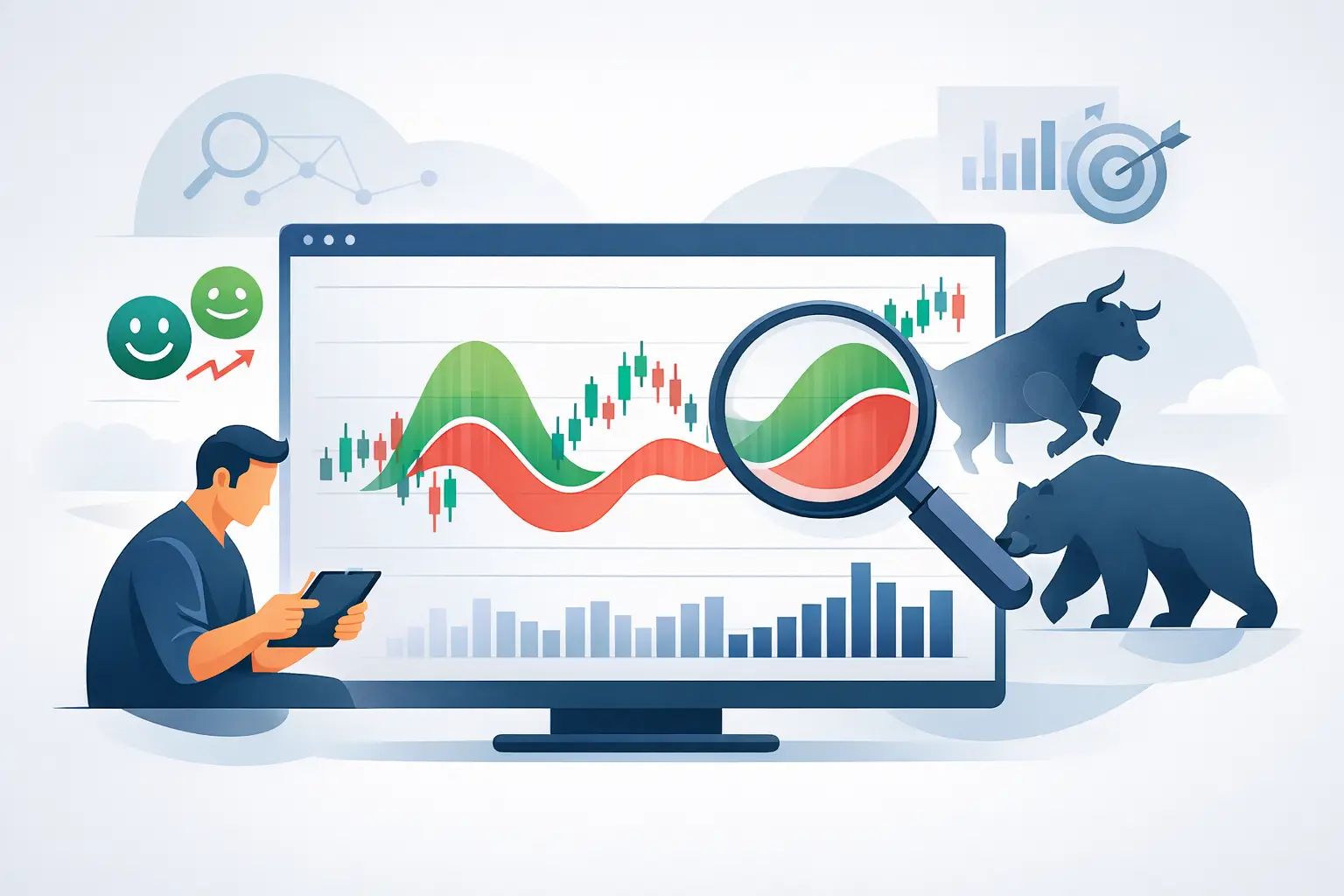
A ticker can become the market’s next conversation hours before its chart confirms it. A stock sentiment tracker gives traders a way to see that conversation forming: which names are gaining attention, what is driving it, whether the catalyst is credible, and how price behavior is responding.
That distinction matters. Raw mentions alone create a false sense of urgency. A ticker can trend because of recycled posts, vague speculation, or a one-off headline with no staying power. Useful sentiment intelligence connects attention to evidence, momentum, and technical context. It helps you monitor the narrative without mistaking noise for conviction.
What a Stock Sentiment Tracker Actually Measures
A stock sentiment tracker monitors how the market is talking about a company and translates that activity into usable ticker-level signals. The strongest platforms do not treat all attention as equal. They separate the underlying inputs, then show how those inputs change over time.
Social sentiment captures the direction and intensity of public discussion. It can reveal when retail attention accelerates, when a narrative turns skeptical, or when a previously quiet ticker starts appearing across trader conversations. Its value is speed. Its weakness is that social activity can be repetitive, emotional, and easily distorted.
News momentum measures the flow and relevance of coverage around a ticker. A verified earnings release, regulatory update, product announcement, analyst action, or sector development carries a different weight than an unsupported post. Tracking source-backed news helps establish whether the market has a concrete reason to focus on a name.
Technical context adds the market’s response. Attention matters more when it appears alongside relative volume, price expansion, changes in trend structure, or an emerging volatility regime. It matters less when conversation grows while the chart remains inactive and liquidity is thin.
The objective is not to create a single magic score that replaces research. It is to compress a large, fragmented information set into a faster decision framework: attention, catalyst, confirmation, and risk context.
Why Attention Often Moves Before Price and Volume
Markets do not process information in one clean event. Narratives typically develop in stages. A new filing, report, product detail, macro development, or sector read-through reaches a small group first. Discussion spreads. Media coverage expands or fades. More participants begin tracking the ticker. Then price and volume may react with force, or the story may fail to gain traction.
A tracker is most valuable during the early middle of that sequence. It can identify unusual changes in attention before a ticker becomes obvious on conventional volume screens. That is especially relevant for momentum traders monitoring crowded watchlists, investors tracking a developing company narrative, and analysts who need to understand why a stock is suddenly on the market’s radar.
Early does not automatically mean actionable. A surge in attention can be the beginning of a meaningful repricing, but it can also mark peak visibility after the important information is already known. The edge comes from judging the quality and persistence of the signal, not merely reacting to the first spike.
The Difference Between Noise and Market-Relevant Sentiment
The fastest way to misuse sentiment data is to rank tickers by mention count and stop there. Mention volume measures awareness. It does not reliably measure relevance, credibility, or directional conviction.
A more disciplined workflow asks four questions. First, is attention accelerating relative to the ticker’s normal baseline? A move from 10 to 100 meaningful mentions can matter more than a familiar large-cap name moving from 10,000 to 11,000. Second, what is the source mix? A burst driven by verified news deserves different treatment than one driven entirely by anonymous social posts.
Third, is the discussion concentrated around a specific catalyst? Broad chatter with no identifiable reason often fades quickly. A focused narrative tied to a reported event is easier to investigate and monitor. Fourth, is price behavior confirming that the market is assigning value to the information? Sentiment and technicals do not need to move in lockstep, but a large disconnect should trigger caution rather than confidence.
This is why transparent evidence feeds matter. Traders should be able to move from a score or alert to the actual news items, conversation themes, and technical readings behind it. Black-box sentiment can be convenient, but it is difficult to trust when the underlying drivers are hidden.
A Practical Workflow for Daily Signal Detection
A sentiment tracker works best as a research layer inside a repeatable market process. Start with premarket or opening-session scans for tickers showing unusual attention. Do not focus only on the top-ranked names. Look for outliers: companies where social momentum, news momentum, or technical activity has shifted sharply from its recent range.
Next, inspect the catalyst. Determine whether the attention is tied to a verifiable event, a sector-wide development, a scheduled corporate event, or a circulating claim that lacks support. This step filters out a large share of low-quality signals quickly.
Then compare the signal across inputs. When verified news momentum rises, social discussion expands, and technical behavior starts to confirm, the narrative has more structure. When one input is flashing while the others remain flat, that does not invalidate the signal. It simply changes how it should be interpreted. A news-led move may precede social acceleration. A social-led move may require stronger validation. A technical move without a clear narrative may point to information that deserves closer investigation.
Finally, add the ticker to a focused watchlist and track change, not just the current reading. Is attention continuing to build? Is sentiment becoming more polarized? Are new sources reinforcing the catalyst? Is the market holding interest after the initial reaction? Time-series behavior is usually more informative than a single snapshot.
Screen for Confluence, Not Hype
The highest-value use case is not finding the loudest ticker. It is finding confluence before it becomes broadly obvious.
A useful screener can surface names where multiple independent signals align: rising verified news momentum, growing social attention, unusual discussion velocity, and technical conditions that show the market is engaged. Independent weighting is critical here. If every input is blended into one opaque measure, a wave of low-quality chatter can overpower a meaningful but quieter news development.
Confluence does not need to be perfect. Markets are messy, and the order of signals changes by setup. A small-cap catalyst may first appear through news, while a consumer-facing story may build through social channels before coverage catches up. The point is to see the components clearly enough to identify what is leading the move and what still needs confirmation.
For portfolio-oriented investors, the same framework can monitor names already under research. A sudden deterioration in sentiment, a decline in credible news flow, or a divergence between an optimistic narrative and weakening technical behavior may signal that the thesis deserves a fresh review. The tool is not only for discovery. It is also for conviction tracking.
Alerts Should Trigger Research, Not Replace It
The best alerts are specific. “Ticker sentiment changed” is rarely enough. A useful alert explains whether social velocity jumped, verified news activity increased, a sentiment threshold was crossed, or a technical condition aligned with the attention shift.
Set different alert logic for different objectives. An active trader may prioritize rapid changes in attention and intraday narrative momentum. A growth-focused investor may care more about sustained news sentiment, recurring themes, and changes that persist across several sessions. A developer building a systematic workflow may need structured inputs delivered through an API, with enough component-level detail to test how each signal behaves.
Alert volume is a trade-off. Broad thresholds catch more potential moves but can flood a watchlist with weak signals. Narrow thresholds reduce noise but may miss early developments. Start with a defined universe and adjust based on the quality of the research opportunities produced, not the number of notifications received.
Build a Better Narrative Map With Sentimentick
Sentimentick is built around this component-level view of market attention. Its dashboard and API separate social sentiment, verified news momentum, and technical analysis so traders and developers can see what is driving a ticker rather than relying on a generic popularity score.
That structure supports faster investigation. You can identify emerging outliers, review the evidence behind the shift, monitor conviction as the narrative develops, and create alerts or screens around the conditions that matter to your process. The goal is simple: catch market shifts before they are fully reflected in familiar price and volume screens.
A stock sentiment tracker earns its place in a serious workflow when it reduces research time without reducing judgment. Watch the change in attention, verify the reason, compare independent signals, and let the evidence determine whether a market narrative is strengthening or simply getting louder.