
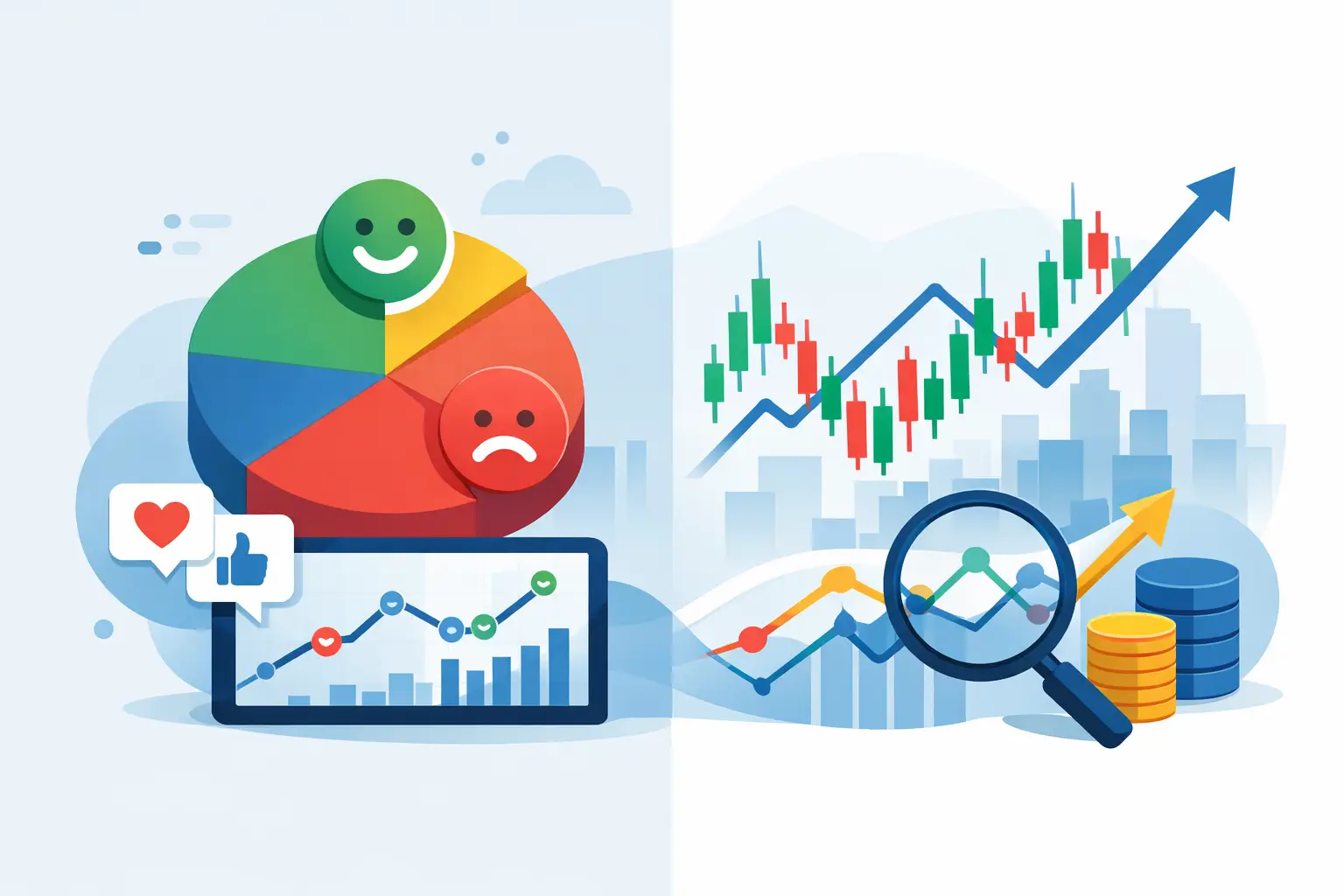
A ticker can trade quietly for hours while attention around it changes fast. A new catalyst gains traction, credible coverage accelerates, and traders begin framing the same narrative across multiple channels. The chart may not reflect that shift yet. That is where sentiment data vs price action becomes a useful framework: one measures the market's visible response, while the other can expose the conditions forming beneath it.
For active traders, this is not a debate over which signal is superior. Price remains the final scoreboard. Sentiment adds context around why attention is building, whether a move has narrative support, and whether a spike in discussion is meaningful or just another burst of noise.
Sentiment Data vs Price Action: Two Different Clocks
Price action records transactions that have already occurred. It reflects participation, liquidity, positioning, and conviction at a specific moment. A breakout, failed reclaim, volume expansion, or tight consolidation offers immediate evidence of how market participants are responding.
Sentiment data measures the information environment around a ticker. It can show changes in social discussion, news momentum, narrative direction, source quality, and the rate at which attention is growing. Its value is not that it predicts every chart move. Its value is that it can flag a change in market focus before that focus becomes obvious in price and volume.
These signals operate on different clocks. Price is fast confirmation. Sentiment can be earlier detection. The gap between them is where research edge often exists.
That gap does not always produce a tradable move. A ticker can attract intense attention and still fail to sustain interest. Sentiment is strongest when it helps answer a narrower question: is the market beginning to care about something new, and is that attention gaining credible momentum?
What Price Action Does Better
Charts cut through narrative. They show whether participants are actually committing capital, whether liquidity is supporting the move, and whether momentum holds after the first reaction. A positive news cycle without follow-through on the chart is still a weak market response.
Price action is especially useful for timing and risk definition. Traders can observe prior highs and lows, volatility compression, relative strength, volume behavior, and reactions around key levels. Those are direct signals, not interpretations of online conversation.
It also protects against a common sentiment mistake: confusing visibility with demand. A stock can dominate social feeds because the story is dramatic, controversial, or highly shareable. That does not mean attention is translating into durable market participation.
When sentiment and price disagree, price deserves respect. If discussion is expanding but the chart repeatedly rejects higher levels or cannot hold gains, the market may be signaling that the narrative lacks conviction. The attention may still matter, but it needs to be treated as watchlist context rather than confirmation.
What Sentiment Data Sees Before the Chart
Price cannot explain what is changing in the information flow. It shows the reaction, not always the reason. Sentiment data can help identify early narrative shifts that a trader might otherwise discover only after a ticker reaches the front of every scanner.
The highest-value signal is rarely raw mention volume. A sudden jump in chatter can come from recycled posts, low-quality accounts, promotional activity, or a single viral thread. More useful evidence includes the pace of attention, the mix of verified news and social discussion, the consistency of the narrative, and whether new participants are joining the conversation.
Consider two tickers with the same increase in mentions. One is driven by a wave of repetitive social posts with no new information. The other shows rising discussion alongside fresh reporting, a clear catalyst, and a steady increase in ticker-specific attention. The total count may look similar. The quality and durability of the signal are completely different.
This is why separating verified news momentum from social sentiment matters. News can establish factual context. Social activity can reveal where trader attention is concentrating. Together, they offer a clearer view of whether a narrative is being built, challenged, or abandoned.
The Strongest Setup Is Alignment, Not Prediction
The most useful relationship between sentiment data and price action is alignment. When attention is increasing, the narrative is clear, credible sources are contributing, and price begins to confirm, the market is providing multiple layers of evidence.
That does not mean every aligned signal will continue. Markets can reverse quickly, especially around crowded narratives or event-driven volatility. But alignment gives a trader a more informed framework than relying on a chart or a social feed in isolation.
There are three broad states to monitor. First, sentiment may lead price: attention and news momentum rise while the chart remains quiet. This is an early research signal, not a conclusion. Second, price may lead sentiment: the chart moves first and attention arrives after the fact. This can indicate an emerging catalyst, but it can also mean the crowd is catching up. Third, both can move together. That is often the cleanest sign that a narrative is reaching the broader market.
The fourth state is divergence. Rising price with fading attention may suggest a move driven by factors that are not visible in public narrative data, or it may signal that the story is already mature. Rising attention with weak price can reflect curiosity without commitment. Neither divergence is automatically bearish or bullish. Both demand better context.
A Practical Workflow for Reading Both Signals
Start with the chart, but do not stop there. Identify where price is relative to recent structure, whether volume is changing, and whether the ticker is showing unusual relative strength or weakness. Then inspect the information flow behind the move.
Ask whether there is a specific catalyst, whether the discussion is accelerating or merely elevated, and whether the conversation is concentrated around one clear narrative. Look for evidence rather than labels. A sentiment score is useful as a filter, but the underlying sources tell you whether the signal deserves attention.
Next, compare the timing. If sentiment has been rising steadily and price is only beginning to react, the market may be moving from awareness to participation. If price already made a sharp move before attention surged, sentiment may be describing a crowded reaction rather than an early shift.
Finally, monitor how the narrative evolves. Does verified coverage broaden? Does social discussion become more informed or more repetitive? Does price hold its structure as attention expands? These questions turn sentiment from a static score into a live measure of market focus.
A platform such as Sentimentick is built for this exact workflow: surfacing unusual attention, separating verified news from social chatter, and giving traders the evidence feed behind a ticker-level narrative. The goal is not to replace chart reading. It is to reduce the time between an emerging shift in attention and a disciplined review of the chart.
Where Traders Misread Sentiment
The biggest error is treating sentiment as a directional command. Positive language does not guarantee sustained upside, and negative language does not guarantee continued downside. Sentiment reflects emotion, expectations, and attention. Markets often move on the difference between expectations and reality.
Another mistake is ignoring baseline behavior. Some tickers naturally generate high social volume. A thousand mentions may be irrelevant for a widely discussed name but highly unusual for a thinly followed stock. The meaningful measure is not just activity. It is activity relative to that ticker's normal attention level.
Source quality matters just as much. Ten credible reports with new information can carry more weight than ten thousand repeated posts. Traders who treat every mention equally end up measuring noise, not conviction.
Use Sentiment to Narrow the Search
No trader can manually track every developing narrative across the US market. Sentiment data is most effective as a prioritization layer. It helps identify where attention is becoming abnormal, which tickers are gaining narrative momentum, and where a chart deserves a closer look.
Price action then determines whether that attention is translating into actual participation. This division of labor is practical: sentiment finds the developing story; price tests the market's response.
The edge is not in choosing sentiment over charts or charts over sentiment. It is in recognizing that markets move through an information phase before they become obvious on every watchlist. Watch the story, verify the evidence, and let price show whether the market agrees.