
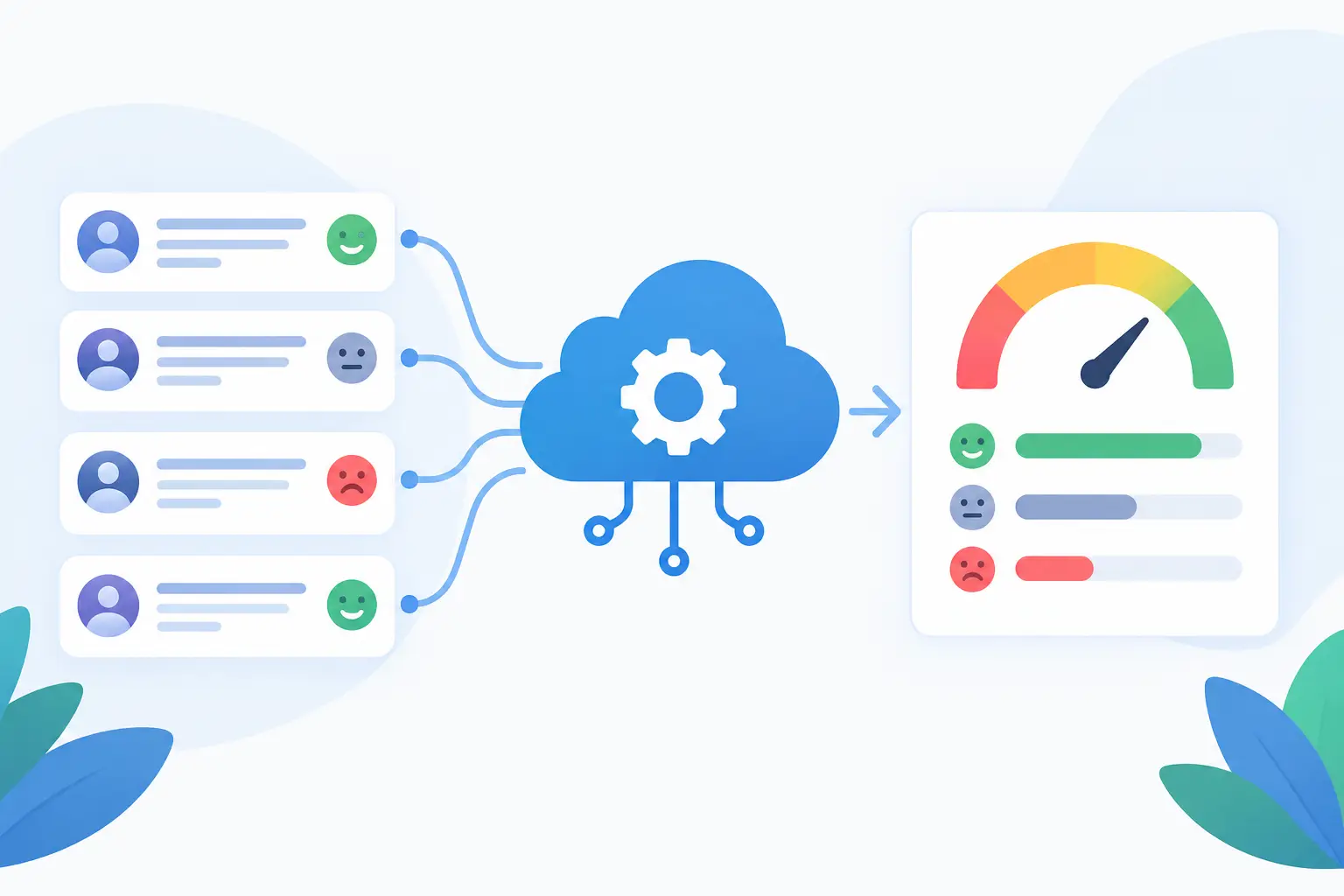
A market narrative can change long before a chart confirms it. A REST API for sentiment scoring gives developers and active traders a programmable way to measure that change across news, social discussion, and ticker-specific attention. The objective is not to collect more posts. It is to identify when the information flow around a symbol is accelerating, improving, deteriorating, or splitting into competing narratives.
For anyone monitoring hundreds or thousands of US equities, that distinction matters. Raw mention volume is easy to retrieve and often misleading. A useful sentiment endpoint needs to preserve context: who is speaking, what source is driving the move, whether the discussion is new, and whether price action supports the story.
What a REST API for Sentiment Scoring Should Deliver
At a minimum, an API response should return more than a positive, negative, or neutral label. Those labels are a starting point, not a market signal. A headline can be positive in isolation while representing a fading catalyst. Social discussion can look bullish while being driven by recycled claims, low-quality accounts, or a late-stage viral spike.
A market-ready REST API for sentiment scoring should make the score usable in a decision system. That means pairing sentiment direction with measurable attributes such as source type, timestamp, ticker mapping, mention velocity, confidence, and evidence. If a model cannot show why a score moved, it is difficult to validate, tune, or trust in a live workflow.
For ticker-level research, the strongest output usually separates at least three layers. News sentiment measures the tone and momentum of verified reporting. Social sentiment measures retail attention and crowd conviction. Technical context shows whether the market is confirming or resisting the narrative. Each layer answers a different question, and combining them without preserving those differences can create false certainty.
Direction is only one dimension
A sentiment score of 0.72 may look actionable until you ask what produced it. Did ten reputable publications report a material development? Did a single widely shared post trigger a burst of speculative commentary? Did the score rise because the language changed, or because mentions suddenly increased?
The API should let users inspect the underlying evidence rather than treat sentiment as a black box. A developer building a screener may rank symbols by sentiment acceleration. An analyst reviewing an alert may need the actual articles and posts behind that acceleration. Both workflows require traceability.
Time windows determine usefulness
Sentiment is highly sensitive to its measurement window. A five-minute score can capture an early reaction but may be noisy. A 24-hour score is more stable but can miss a fast-changing catalyst. A seven-day score helps frame broader narrative persistence but may conceal an intraday reversal.
The practical answer is not to choose one window. It is to retrieve several and compare them. When short-term sentiment turns sharply positive while the longer window remains flat, a new narrative may be forming. When short-term sentiment weakens against a still-strong weekly reading, attention may be cooling rather than collapsing. The interpretation depends on the ticker, liquidity, catalyst type, and trading horizon.
Build the Data Contract Before the Model
The fastest way to weaken a sentiment integration is to start with a score and decide later how it will be used. Define the output contract first. Establish the symbols, timeframes, update frequency, fields, and alert thresholds your application needs before selecting an endpoint or designing a pipeline.
A developer dashboard may need a latest-score endpoint for a watchlist, a historical endpoint for charting, and an evidence endpoint for review. A systematic workflow may need batched symbol queries, normalized timestamps, pagination, rate-limit behavior, and stable field definitions. These are product requirements, not implementation details.
A practical response schema often includes a ticker, observation timestamp, score, confidence measure, source category, mention count, mention velocity, and an evidence reference or summary. It should also state the scoring range clearly. A value on a -1 to 1 scale means something different from a 0 to 100 index, especially when thresholds drive alerts or downstream rules.
Historical consistency deserves special attention. If model changes alter the meaning of a score, users need versioning or documentation that makes backtests interpretable. A score series that quietly changes methodology can produce attractive but unreliable historical results. Market data systems need stable definitions as much as they need low latency.
Separate Signal From Attention
High attention is not automatically high conviction. In fact, the most discussed tickers often generate the noisiest sentiment data. A REST API designed for market analysis should distinguish the amount of conversation from the quality and direction of that conversation.
Consider two symbols. The first receives a modest but consistent stream of constructive reporting from verified sources, with rising technical confirmation. The second sees a sudden explosion of social mentions driven by vague claims and repeated reposts. A mention-count leaderboard may put the second symbol first. A signal-aware scoring system should make the difference visible.
This is where source weighting matters. Verified news, original analysis, social posts, and reposts do not carry equal informational value. Weighting should reflect the platform's methodology, while keeping the individual components available to the user. An opaque blended score is convenient, but it can hide the exact disagreement that creates an opportunity for deeper research.
Sentimentick approaches this by treating verified news momentum, social chatter, and technical indicators as independent inputs. That structure helps developers avoid a common error: allowing a loud social spike to overwrite a more durable evidence trail from news and market behavior.
Use Score Changes, Not Just Score Levels
A high sentiment reading can persist for days or weeks. That may be meaningful, but the change in sentiment is often more useful than the absolute level. Markets respond to new information and changing expectations. Your API workflow should therefore calculate deltas, acceleration, and persistence alongside the current score.
For example, a watchlist process might compare the latest 30-minute score with its prior 30-minute value, then measure the same symbol against its five-day baseline. This helps distinguish a stable positive narrative from a fresh shift in the information flow. Add mention velocity and source composition, and the signal becomes more specific.
A simple framework can classify conditions without pretending that one metric predicts every move:
- Rising sentiment with rising verified-news momentum suggests a narrative gaining institutional-quality support.
- Rising social sentiment without news confirmation may indicate attention that requires stricter filtering.
- Falling sentiment with elevated attention can reveal disagreement, uncertainty, or a narrative under pressure.
- Flat sentiment with a sharp rise in mentions often signals that attention is increasing before direction becomes clear.
These are research states, not automatic actions. Their value comes from narrowing a large market into a smaller set of symbols that deserve immediate review.
Engineer for Latency, Limits, and Failure Modes
Sentiment data loses value when it arrives after the market has absorbed the catalyst. But minimizing latency does not mean polling every endpoint every second. Excessive polling raises costs, hits rate limits, and can introduce duplicate data into downstream systems.
Use the API cadence that matches the signal's half-life. Intraday alerting may require frequent updates for an active watchlist. Portfolio research may only need hourly or end-of-day refreshes. Batch requests where possible, cache stable historical results, and reserve real-time capacity for symbols with active attention or specific trigger conditions.
Failure handling is equally important. Market applications should expect delayed source ingestion, temporary endpoint errors, sparse coverage, ticker changes, and ambiguous entity mapping. A blank sentiment result should not be silently treated as neutral. It may mean no coverage, an unresolved mapping issue, or a delayed pipeline. Preserve status fields so the consuming application can distinguish missing data from an actual score.
Rate limits should shape product design early. If a custom screener monitors thousands of symbols, request only the fields needed for the first pass. Retrieve full evidence and history after a symbol passes the initial filter. This two-stage design lowers API usage while keeping the evidence workflow fast where it matters.
Turn Scores Into a Research Workflow
The best API integrations do not stop at a number in a database. They route changing conditions into a repeatable research process. Start with a universe, screen for sentiment acceleration or unusual divergence, inspect the evidence feed, compare the move with technical context, and log what changed.
That workflow creates a feedback loop. Over time, users can test whether certain combinations of source quality, sentiment velocity, and price confirmation have been informative for their strategy. They can also identify where the model produces noise, then tighten filters by market cap, liquidity, sector, source mix, or time of day.
A REST API for sentiment scoring earns its place when it reduces the time between narrative change and informed analysis. Treat it as a signal layer with evidence, timing, and context - not a standalone verdict. The edge is not in seeing every conversation. It is in recognizing which shifts deserve attention while the market is still deciding what they mean.