
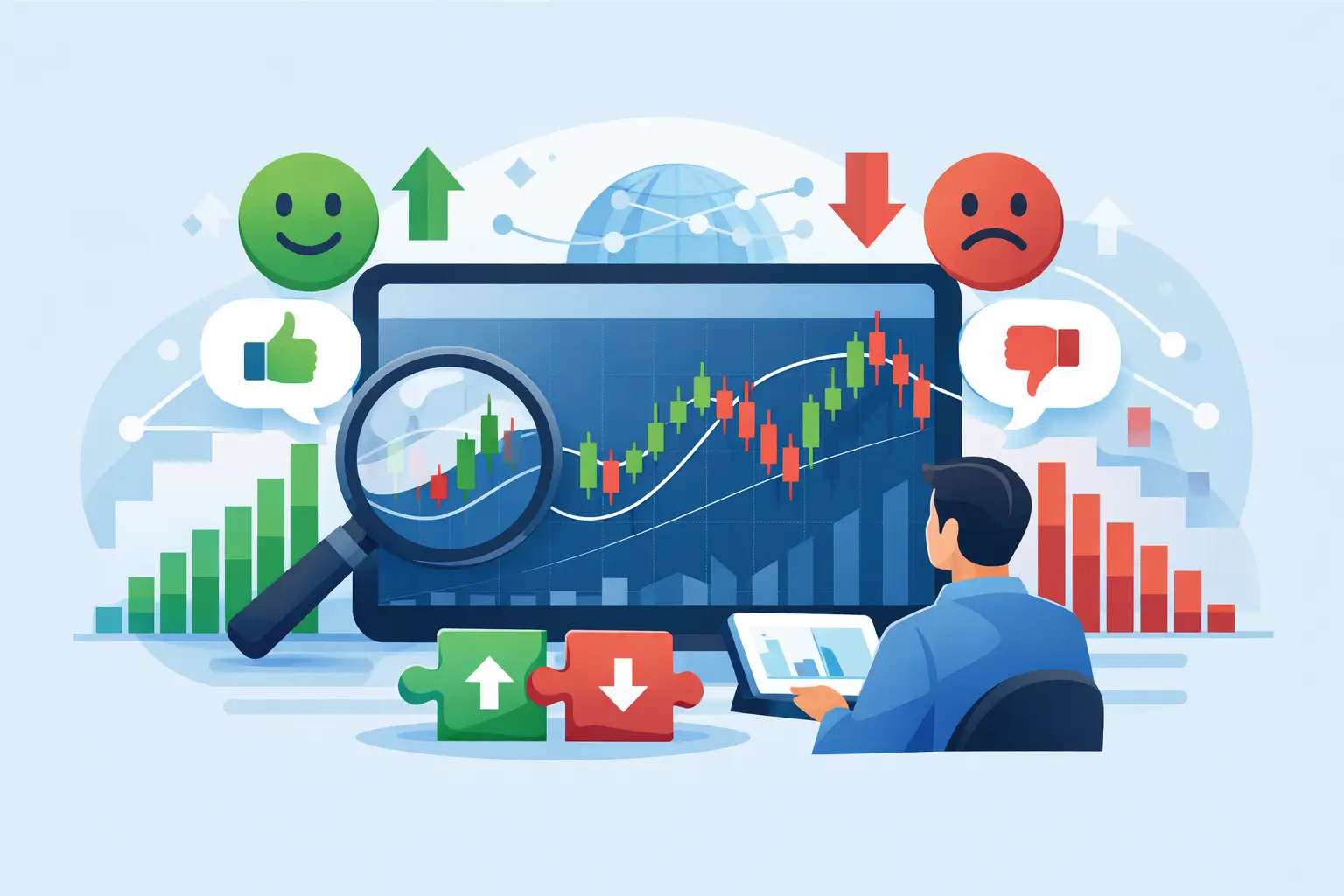
Most traders do not lose the move because they missed the chart. They lose it because they missed the story forming before the chart changed. Best stock sentiment analysis is about catching that shift early enough to matter, then judging whether the attention is noise, confirmation, or the start of a real narrative repricing.
That distinction matters more than ever. A ticker can trend for hours on social chatter and go nowhere. Another can pick up steady verified news momentum, show rising discussion quality, and turn into a multi-session setup before most screens flag it. If you trade on short- to medium-term timeframes, sentiment is not a side input anymore. It is part of market structure.
What best stock sentiment analysis actually means
A lot of traders use the phrase loosely. In practice, the best stock sentiment analysis is not just a bullish or bearish score next to a ticker. It is a system for measuring attention, context, and narrative direction in a way that helps you make faster research decisions.
A useful sentiment framework answers a few specific questions. Is attention expanding or fading? Is the conversation driven by verified reporting or social speculation? Is the tone improving, deteriorating, or splitting into conflicting narratives? Is this a one-hour spike or the early stage of a theme that could carry over several sessions?
If a tool cannot answer those questions, it is giving you decoration, not edge.
Why raw sentiment scores are not enough
A single score looks clean, but markets are rarely that simple. Two stocks can both show strong positive sentiment while representing completely different setups. One might be getting credible coverage tied to earnings guidance, regulatory developments, or sector spillover. The other might be riding short-lived excitement with no sustained evidence behind it.
That is why the source mix matters. Social velocity can be an early detector, especially for retail-driven attention, but it is also where false positives multiply. Verified news momentum tends to move slower, yet often carries more informational weight. The best stock sentiment analysis treats these as separate signals first, then helps traders interpret the relationship between them.
When both rise together, that can signal broadening conviction. When social chatter surges while verified news stays flat, you may be looking at a weak signal that needs more caution. When news breaks before social engagement catches up, you may be early to a narrative that is not fully crowded yet.
The inputs that separate signal from noise
Strong sentiment analysis starts with data quality. Not all mentions are equal, and not all attention should be treated as meaningful. Traders need systems that rank relevance instead of counting everything the same.
The first layer is source quality. Verified media, company-specific reporting, and high-signal financial discussion generally deserve more weight than recycled posts, meme traffic, or generic market commentary. The second layer is ticker precision. If a system struggles to separate true ticker mentions from irrelevant chatter, the output becomes unreliable fast.
The third layer is time sensitivity. Sentiment that updates once or twice a day is too slow for active workflows. Attention can accelerate, reverse, or fragment within a single session. Real-time monitoring matters because narrative shifts often happen before price fully reacts.
The fourth layer is evidence. A score without an evidence feed forces traders to trust the label without seeing what caused it. That is a weak workflow. You want to inspect the headlines, posts, and momentum drivers behind the move so you can judge conviction for yourself.
How traders should evaluate a sentiment tool
Most sentiment tools look good in a demo because bright dashboards compress complexity. The better test is whether the product improves your decision speed without hiding the underlying context.
Start with latency. If the data arrives after the market has already digested the story, it is not giving you much. Then look at source separation. Traders need to know whether a move is coming from social attention, verified news, or both. Blending everything into one number can blur the setup.
Next, check whether the platform tracks narrative evolution over time. Sentiment is not just a snapshot. It is a sequence. A stock may move from ignored, to questioned, to validated, to crowded. If your tool only shows the current reading, you lose the shape of the move.
Screening and alerting also matter. A sentiment dataset is only useful if you can surface outliers across a wide universe without watching every ticker manually. For technically fluent users, API access is another serious advantage because it lets sentiment become part of a broader research stack rather than a disconnected widget.
Best stock sentiment analysis uses for active traders
The highest-value use case is not prediction in the abstract. It is prioritization. Sentiment helps traders decide which tickers deserve immediate attention, which setups are gaining narrative support, and which headlines are being overreacted to.
For momentum traders, sentiment can identify unusual attention before volume expansion becomes obvious on standard scans. That does not mean every spike matters. It means the ticker has earned a place on the board for deeper review.
For swing traders, sentiment is useful for tracking whether a catalyst is sustaining interest across multiple sessions. Some stories fade as quickly as they appear. Others keep attracting media reinforcement, fresh discussion, and sector sympathy. The difference often shows up in narrative persistence before it becomes obvious in price structure.
For discretionary analysts, sentiment helps with risk framing. If a stock is technically clean but the underlying narrative is deteriorating, that changes the quality of the setup. If the chart is still early while attention quality keeps improving, that can justify closer monitoring.
Where sentiment analysis goes wrong
The biggest mistake is treating sentiment as a stand-alone trigger. It works better as a context engine than as an isolated decision rule. High sentiment by itself does not tell you whether the move is extended, fragile, or backed by durable information.
Another common error is overvaluing volume of mentions. More discussion does not automatically mean more conviction. Sometimes it just means more repetition. Traders need to ask whether the story is developing or merely echoing.
There is also regime dependence. In quiet markets, small shifts in attention can matter more because fewer names compete for focus. In highly reactive tape, sentiment can spike across many tickers at once, making relative ranking more important than absolute scores.
And then there is the lag problem. Some tools identify what has already become obvious. That may still be useful for confirmation, but it is not the same as early signal detection. If your goal is edge, timing is not a minor detail. It is the whole point.
What an effective sentiment workflow looks like
A practical workflow starts with outlier detection. You scan for unusual attention, sentiment acceleration, or fresh narrative momentum across your universe. Then you validate the source mix. Is the move backed by verified reporting, social expansion, or a mismatch between the two?
Next, inspect the evidence feed. Read enough of the underlying inputs to understand what the market is actually reacting to. This step matters because labels can compress nuance. A stock can show positive sentiment even when the conversation is speculative, divided, or based on low-quality repetition.
Then move to persistence. Is the signal building over time or fading after the initial burst? Narrative durability often separates tradable follow-through from random noise. This is where ticker-level tracking becomes valuable because it shows whether the story is evolving, not just whether people are talking.
A platform like Sentimentick fits this workflow well because it separates social sentiment from verified news momentum, shows the evidence behind the signal, and makes it easier to monitor how the narrative around a stock changes as the session develops.
What the best stock sentiment analysis should deliver
The best stock sentiment analysis should do three things exceptionally well. First, it should surface attention shifts early enough to change your research queue. Second, it should help you distinguish signal quality instead of flattening every mention into the same value. Third, it should preserve context so you can see why sentiment changed, not just that it changed.
That is the real standard. Not flashy dashboards. Not broad claims about AI. Not a single magic score pretending to solve market complexity. Traders need speed, source clarity, and evidence-backed context they can act on fast.
If your sentiment workflow helps you spot emerging attention before the crowd, judge whether that attention is credible, and track whether the narrative is strengthening or cracking, it is doing its job. In active markets, that edge compounds long before it shows up on the chart.